What Does Peptide Purity Mean? Understanding HPLC and LC-MS Results
Peptide purity is one of the most frequently highlighted specifications when research compounds are assessed, compared or purchased. However, a headline purity percentage does not tell researchers everything about a sample. Understanding what the figure represents, how it was measured and whether the compound’s identity and quantity were also verified is essential when reviewing analytical documentation.
High-performance liquid chromatography, commonly abbreviated as HPLC, and liquid chromatography-mass spectrometry, known as LC-MS, are two analytical techniques frequently used when evaluating synthetic peptides. Although both can contribute valuable information, they answer different questions and should not be treated as interchangeable.
This guide explains what peptide purity means, how HPLC and LC-MS results are interpreted and what researchers should look for when reviewing documentation for products such as the Reta Pen 20mg and Reta Pen 40mg.
What Does Peptide Purity Mean?
Peptide purity generally refers to the proportion of detected peptide-related material attributed to the principal target compound rather than impurities, degradation products or other components detected during an analysis.
For example, an HPLC report showing a principal peak with a high area percentage may indicate that most of the ultraviolet-detectable material under the selected testing conditions is associated with that peak. However, the figure does not automatically confirm the exact identity of the principal peak or the total weight of peptide present within the complete product.
Peptide purity should therefore be reviewed alongside other analytical information, including:
- Molecular identity confirmation
- Total peptide quantity
- Batch or lot number
- Testing method and conditions
- Chromatographic profile
- Sample description
- Date of analysis
- Relevant analytical limitations
Researchers should avoid treating one percentage as a complete quality assessment. A reliable review considers the full report and the scope of testing performed.
Why Peptide Purity Matters in Laboratory Research
Impurities can complicate laboratory research by introducing additional compounds into an analytical or experimental system. Depending on the peptide, synthesis process and storage conditions, impurities may include incomplete peptide sequences, modified sequences, residual synthesis-related material or degradation products.
Understanding the purity profile can help researchers assess whether a sample is appropriate for the intended study and whether unexpected analytical results could be influenced by other detectable components.
Purity information may support:
- Analytical method development
- Comparative product evaluation
- Receptor-binding research
- Cellular-signalling studies
- Batch comparison
- Inventory qualification
- Internal procurement procedures
- Research reproducibility
The required purity level depends on the study design, analytical sensitivity and institutional requirements. Researchers should determine appropriate specifications within their approved laboratory protocols.
What Is HPLC?
High-performance liquid chromatography is an analytical technique used to separate components within a sample. During analysis, the sample travels through a chromatographic column, and different components may separate according to their chemical interactions with the mobile and stationary phases.
The separated components appear as peaks within a chromatogram. The position of each peak is associated with its retention time, while the detected peak area can be used to estimate the relative proportion of material represented by that signal under the chosen analytical conditions.
Reverse-phase HPLC is widely used for peptide analysis because it can separate peptide-related components according to differences in hydrophobicity. The method may help reveal whether the sample contains one dominant component or several detectable components.
How HPLC Peptide Purity Is Calculated
HPLC purity is frequently reported using peak-area normalisation. Under this approach, the area of the principal chromatographic peak is compared with the combined area of the relevant detected peaks.
A simplified example would be a chromatogram where the principal peak represents 98% of the integrated peak area and the remaining detected peaks represent 2%. The report may describe the sample as having 98% chromatographic purity under the stated method.
This does not necessarily mean that 98% of the total product weight is the target peptide. The complete product may also contain components that are not detected effectively by the selected detector or are excluded from the chromatographic integration.
These may include:
- Water or residual moisture
- Counterions
- Buffer components
- Salts
- Excipients
- Solvents
- Materials with limited detector response
HPLC purity is therefore best understood as a relative chromatographic measurement rather than a direct statement of total product composition by weight.
What an HPLC Chromatogram Shows
An HPLC chromatogram presents the detector response over time as components leave the column. Researchers may review the chromatogram to assess the main peak and any secondary peaks detected during the analysis.
Important chromatogram features may include:
- The retention time of the principal peak
- The number of additional detected peaks
- The relative area of each integrated peak
- Peak shape and symmetry
- Separation between adjacent peaks
- The detector wavelength used
- The integration parameters
- The mobile-phase gradient
A large principal peak may indicate that one component dominates the chromatographic profile. However, identity testing is still required to support the conclusion that this peak corresponds with the expected peptide.
What HPLC Cannot Confirm by Itself
HPLC can provide useful separation and relative purity information, but it does not automatically provide complete molecular identification. Two compounds may sometimes display similar retention behaviour under a particular chromatographic method.
An HPLC report alone may not establish:
- The definitive molecular identity of the principal peak
- The complete amino-acid sequence
- The exact total amount of peptide in the product
- Sterility
- Endotoxin content
- Residual solvent levels
- Microbial contamination
- Long-term stability
- Suitability for human or veterinary administration
Researchers should check the scope of the report rather than assuming that an HPLC purity result covers characteristics that were not tested.
What Is LC-MS?
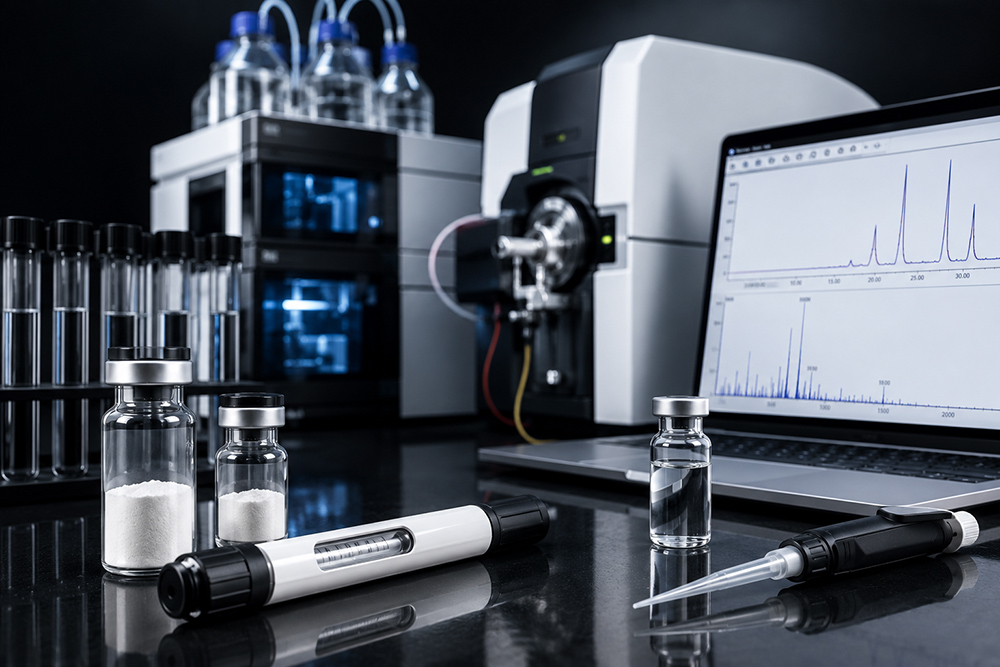
Liquid chromatography-mass spectrometry combines chromatographic separation with mass spectrometric detection. The liquid chromatography stage separates sample components, while the mass spectrometer evaluates ions according to their mass-to-charge ratios.
LC-MS can support peptide identification by determining whether a detected molecular signal corresponds with the expected molecular mass of the target compound. It may also reveal additional peptide-related components, modified forms or degradation products where they fall within the scope and sensitivity of the method.
This makes LC-MS particularly useful when researchers need more information about the identity of chromatographic peaks rather than relying only on retention time and ultraviolet detection.
How LC-MS Supports Peptide Identity Confirmation
A synthetic peptide has an expected molecular formula and molecular mass based on its amino-acid sequence and chemical modifications. LC-MS analysis may detect ions corresponding with the expected peptide in one or more charge states.
The observed signals can be processed to estimate the neutral molecular mass of the compound. When this aligns with the expected value within the method’s tolerance, it supports identification of the peptide.
Identity confirmation may consider:
- Expected molecular mass
- Observed mass-to-charge signals
- Detected charge states
- Deconvoluted molecular mass
- Retention time
- Isotopic pattern
- Known molecular modifications
- Related impurity signals
The exact level of identity confirmation depends on the instrument, method and analysis performed. A basic mass match is not always equivalent to full sequence confirmation.
HPLC vs LC-MS: What Is the Difference?
HPLC and LC-MS are complementary rather than competing analytical techniques. HPLC is commonly used to separate components and estimate relative chromatographic purity, while LC-MS adds mass-based information that can support compound identification.
| Feature | HPLC | LC-MS |
|---|---|---|
| Primary purpose | Separation and relative purity assessment | Separation and mass-based identification |
| Typical output | Chromatogram with integrated peaks | Chromatogram and mass spectrum |
| Can estimate chromatographic purity | Yes | Depending on the method |
| Can support molecular identity | Limited when used alone | Yes |
| Confirms total peptide quantity | Not automatically | Only with suitable validated quantitative analysis |
| Detects every possible impurity | No | No |
Using HPLC and LC-MS together can provide a more informative assessment than relying on either headline result in isolation.
Peptide Identity, Purity and Quantity Are Different Measurements
One of the most important principles when reading peptide reports is that identity, purity and quantity answer different analytical questions.
Peptide Identity
Identity testing asks whether the sample contains the expected peptide. LC-MS is commonly used to support this assessment by comparing the observed molecular mass with the expected compound.
Peptide Purity
Purity testing asks what proportion of the relevant detected material is associated with the target peptide or principal chromatographic component. HPLC peak-area analysis is frequently used for this purpose.
Peptide Quantity
Quantity testing asks how much of the target peptide is present within the submitted product. This requires an appropriate quantitative method and should not be inferred solely from an HPLC purity percentage.
A sample can display high chromatographic purity while containing less total peptide than the label states. It can also contain the expected quantity while showing additional detectable impurities. Researchers should therefore review all three measurements where they are relevant to the project.
Does 99% Purity Mean the Product Is 99% Peptide by Weight?
Not necessarily. A reported HPLC purity of 99% commonly means that the principal integrated chromatographic peak accounted for approximately 99% of the relevant detected peak area under the conditions used.
This is not automatically equivalent to saying that 99% of the complete product mass consists of the target peptide. The sample may contain water, salts, counterions or other non-peptide components that are not represented proportionally by the chromatographic purity result.
Researchers looking for net peptide content should review whether an appropriate quantity or content assay was performed in addition to HPLC purity testing.
Common Peptide Impurities
Synthetic peptide production can generate several types of related impurities. Their presence and detectability depend on the synthesis method, purification process, formulation, storage conditions and analytical technique used.
Potential peptide-related impurities may include:
- Truncated peptide sequences
- Deletion sequences
- Incomplete coupling products
- Oxidised variants
- Deamidated variants
- Hydrolysed material
- Aggregated material
- Residual protecting-group derivatives
- Isomeric or modified peptide forms
- Storage-related degradation products
No single method necessarily detects every possible impurity. A complete characterisation programme may require multiple complementary techniques.
Why Testing Conditions Affect Purity Results
Chromatographic results can be influenced by the analytical method. Column chemistry, mobile phase, gradient, temperature, flow rate, detector wavelength and integration settings can all affect separation and the appearance of the chromatogram.
Two laboratories may produce slightly different purity values for the same sample if their methods and integration procedures differ. Researchers should therefore review the method information rather than comparing percentages without context.
Relevant conditions may include:
- Column type and dimensions
- Mobile-phase composition
- Gradient programme
- Flow rate
- Column temperature
- Detection wavelength
- Sample concentration
- Injection volume
- Peak-integration rules
How to Read a Peptide HPLC Report
When reviewing an HPLC report, researchers should look beyond the stated purity percentage and examine whether sufficient supporting information has been provided.
Useful details may include:
- Product or sample name
- Batch or lot reference
- Date of analysis
- Analytical method
- Column information
- Detector wavelength
- Full chromatogram
- Retention times
- Integrated peak table
- Main-peak area percentage
- Analyst or laboratory details
- Report-verification information
A purity figure without a chromatogram, method or batch reference provides less useful information than a complete, traceable analytical report.
How to Read a Peptide LC-MS Report
An LC-MS report should provide enough information to connect the submitted sample with the detected mass signals and expected peptide identity.
Researchers may wish to review:
- The expected molecular mass
- The observed molecular mass
- The permitted mass tolerance
- The detected mass-to-charge signals
- The deconvoluted spectrum
- The chromatographic retention time
- Additional detected peptide signals
- The sample and batch description
- The date and scope of testing
A report should clearly distinguish between confirming the expected molecular mass and performing broader impurity or sequence characterisation.
Why Batch-Specific Testing Matters
Analytical results apply to the sample that was submitted for testing. A report associated with one production batch should not automatically be treated as verification of every later batch carrying the same product name.
Batch-specific testing supports traceability by connecting the analytical findings with the product supplied. Researchers should confirm that the batch or lot reference on the report matches the material being purchased.
This principle applies when reviewing documentation for the Reta Pen 20mg and Reta Pen 40mg. Documentation for one presentation, quantity or production lot should not automatically be used to verify another.
Purity Testing for Reta Pen Research Products
Apex Pharma supplies retatrutide research presentations including the Reta Pen 20mg and Reta Pen 40mg. Both contain the same investigational retatrutide compound, with the principal distinction being the total quantity supplied.
The Reta Pen 20mg may suit smaller analytical, exploratory or preliminary research projects. The Reta Pen 40mg provides a larger presentation that may be more practical for broader or longer-term laboratory programmes.
When reviewing analytical documentation for either product, researchers should check:
- Whether retatrutide identity was confirmed
- Which method was used for purity testing
- Whether total peptide quantity was measured
- Whether the report matches the exact batch
- Whether the stated presentation size matches the sample
- Whether the complete chromatogram is available
- Whether the analytical report can be verified
A high purity result for the Reta Pen 20mg does not by itself confirm the total peptide quantity unless an appropriate content analysis was also performed. The same distinction applies to the Reta Pen 40mg.
Reta Pen 20mg vs Reta Pen 40mg
| Feature | Reta Pen 20mg | Reta Pen 40mg |
|---|---|---|
| Investigational compound | Retatrutide | Retatrutide |
| Total presentation | 20mg | 40mg |
| Molecular identity | Identical compound | Identical compound |
| Potential project scale | Smaller or exploratory studies | Larger or longer-term programmes |
| Documentation review | Exact product and batch | Exact product and batch |
| Intended purpose | Laboratory research only | Laboratory research only |
The larger presentation does not represent a different type of retatrutide. Researchers should select between the Reta Pen 20mg and Reta Pen 40mg according to research requirements, inventory planning and the total amount of material required.
Certificate of Analysis vs Independent Testing
A Supplier Certificate of Analysis and an independent analytical report can both provide valuable information, but they are not necessarily the same type of document.
A Supplier Certificate of Analysis may contain internal batch information, product specifications and quality-control results. An independent report is produced by an external analytical laboratory following examination of a submitted sample.
Researchers should check:
- Who issued the document
- Which sample was analysed
- Whether the batch number is shown
- Which tests were commissioned
- Whether identity, purity and quantity were assessed separately
- Whether the report can be independently verified
Where both forms of documentation are available, researchers can compare the supplier’s batch information with the independent analytical findings.
What a High Purity Result Does Not Guarantee
A high chromatographic purity result can be useful, but it should not be interpreted as proof of characteristics outside the scope of the analysis.
Unless specifically tested, an HPLC or LC-MS report may not establish:
- Sterility
- Endotoxin levels
- Microbial quality
- Residual solvent content
- Particulate contamination
- Container integrity
- Long-term product stability
- Safety for administration
- Regulatory approval
Analytical testing should be interpreted according to the methods performed and should not be extended to claims that the report does not support.
Warning Signs When Reviewing Peptide Purity Claims
Researchers should approach purity claims cautiously where the analytical evidence is incomplete, unclear or impossible to connect with the supplied product.
Potential warning signs include:
- A purity percentage without a chromatogram
- No analytical method listed
- No product or sample identification
- No batch or lot reference
- An edited or cropped report
- A report that cannot be verified
- One report reused for several unrelated products
- Quantity claims based only on an HPLC area percentage
- No distinction between identity and purity testing
- A testing date unrelated to the current production batch
Professional product photography or website design should not replace meaningful analytical documentation.
Questions to Ask a Peptide Supplier
Before purchasing a research peptide, laboratories and individual researchers may wish to ask the supplier several questions about analytical testing.
- Is a batch-specific Certificate of Analysis available?
- Has the peptide identity been confirmed?
- Was purity measured using HPLC?
- Is the complete chromatogram available?
- Was LC-MS used to support molecular identification?
- Was total peptide quantity measured separately?
- Does the report match the exact batch being sold?
- Can the report be independently verified?
- Were additional quality tests performed?
- Will newer batches receive separate documentation?
Why Transparent Peptide Testing Matters
Transparent analytical documentation allows researchers to make better-informed purchasing and inventory decisions. It can also support batch comparison, procurement records and the interpretation of unexpected laboratory findings.
HPLC and LC-MS results are most useful when researchers understand what each method measures. HPLC can provide a relative chromatographic purity profile, while LC-MS can support molecular identification and help characterise peptide-related components.
When assessing products such as the Reta Pen 20mg and Reta Pen 40mg, researchers should review purity, identity, quantity and batch traceability as separate but connected considerations.
Frequently Asked Questions
What does peptide purity mean?
Peptide purity generally refers to the proportion of relevant detected material associated with the principal target compound rather than other detected components. The exact meaning depends on the analytical method used.
What does HPLC show for a peptide?
HPLC separates sample components and produces a chromatogram. The relative areas of the detected peaks can be used to estimate chromatographic purity under the stated testing conditions.
What does LC-MS show?
LC-MS combines chromatographic separation with mass spectrometry. It can support peptide identification by comparing the detected molecular mass with the expected compound.
Does 99% HPLC purity mean that 99% of the product weight is peptide?
Not necessarily. A 99% HPLC result usually describes the relative area of the principal detected chromatographic peak. It does not automatically account for water, salts, counterions or other non-detected components.
Does HPLC confirm peptide identity?
HPLC retention behaviour can support comparison, but it does not always provide definitive molecular identification by itself. LC-MS or another suitable identity method may also be required.
Are peptide purity and peptide quantity the same?
No. Purity describes the relative proportion of the target component among relevant detected material. Quantity describes the total amount of the target peptide within the sample.
Are analytical reports available for the Reta Pen 20mg and Reta Pen 40mg?
Certificates of Analysis or independent analytical reports may be available for selected products and batches. Researchers should review the relevant product page or contact Apex Pharma for current documentation.
What is the difference between the Reta Pen 20mg and Reta Pen 40mg?
The primary difference is the total quantity of retatrutide supplied. Both presentations contain the same investigational compound, but the 40mg option provides twice the total amount.
Important Research Use Notice
All products supplied by Apex Pharma, including the Reta Pen 20mg and Reta Pen 40mg, are intended exclusively for controlled laboratory, analytical and scientific research.
They are not intended for human or veterinary use and are not approved as medicines, food products, dietary supplements, cosmetics or medical devices. They must not be consumed, self-administered, used therapeutically or incorporated into personal experimentation.
Analytical reports describe the submitted sample and tests performed. A purity or identity result must not be interpreted as approval for clinical use or as evidence of suitability for administration.