How Peptide Purity Is Tested: A Guide to HPLC, LC-MS and Batch Verification
Peptide purity testing plays an important role in laboratory procurement, analytical research and product quality assessment. A high purity percentage can appear reassuring, but it should never be viewed as complete proof that a research product contains the correct peptide, the stated quantity or a material suitable for a particular laboratory procedure.
Researchers should evaluate several separate characteristics, including molecular identity, chromatographic purity, total quantity and batch traceability. High-performance liquid chromatography, usually abbreviated to HPLC, and liquid chromatography-mass spectrometry, commonly known as LC-MS, are two of the most widely referenced methods used to investigate these characteristics.
This guide explains what HPLC and LC-MS can reveal, how peptide purity percentages are calculated, why batch verification matters and what researchers should check when reviewing documentation for products such as Reta 20mg, Reta Pen 20mg and Reta Pen 40mg.
What Does Peptide Purity Mean?
Peptide purity usually describes the proportion of detected material associated with the principal peptide component under a particular analytical method. In many cases, the purity percentage is calculated from an HPLC chromatogram by comparing the area of the main peak with the combined area of the other relevant detected peaks.
A reported result of 99% purity generally means that the principal peak accounted for approximately 99% of the integrated chromatographic signal under the conditions used. It does not necessarily mean that 99% of the entire vial contents consist of active peptide by weight.
Peptide purity does not automatically confirm:
- The exact molecular identity of the compound
- The complete amino-acid sequence
- The total quantity contained in the product
- The concentration of a prepared liquid
- Sterility or microbiological quality
- The absence of endotoxins
- Long-term stability
- Suitability for human or veterinary use
Purity should therefore be reviewed alongside identity testing, quantity measurements and batch-specific documentation.
Identity, Purity and Quantity Are Different Measurements
Researchers should distinguish clearly between peptide identity, purity and quantity. These terms are sometimes grouped together in marketing material, but each answers a different analytical question.
| Analytical Characteristic | Question It Answers | Common Method |
|---|---|---|
| Identity | Is the detected material consistent with the expected peptide? | LC-MS or mass spectrometry |
| Purity | What proportion of the detected material is associated with the main component? | HPLC or related chromatography |
| Quantity | How much target peptide is present in the submitted sample? | Validated quantitative analysis |
| Concentration | How much target peptide is present within a defined liquid volume? | Quantitative analysis and volume verification |
| Batch traceability | Does the report match the exact production lot being purchased? | Batch and lot-number verification |
A sample could display high chromatographic purity while containing less total peptide than stated. It could also contain one dominant compound that is not the peptide named on the label. This is why multiple analytical checks are preferable to relying on one headline percentage.
What Is HPLC Peptide Testing?
High-performance liquid chromatography is a separation technique used to examine the components within a sample. The material is dissolved in a suitable mobile phase and passed through a specialised column under pressure.
Different compounds interact with the column and mobile phase in different ways. This causes them to pass through the system at different rates, known as retention times. A detector records the separated components and produces a graph called a chromatogram.
HPLC may help researchers evaluate:
- The relative purity of the principal peptide component
- The number of additional detected components
- Possible synthesis-related impurities
- Potential degradation products
- Differences between production batches
- Changes caused by unsuitable storage
- The consistency of a purification process
The largest peak is often treated as the target peptide peak, but this assignment should ideally be supported by molecular identity testing rather than assumed from retention time alone.
How Is HPLC Purity Calculated?
HPLC purity is commonly calculated using peak-area normalisation. The area of the principal peak is divided by the combined area of all relevant integrated peaks and expressed as a percentage.
For example, if the main peak represents 98.8% of the total integrated signal, the sample may be reported as 98.8% pure by HPLC. This percentage applies only to the compounds detected under the selected analytical conditions.
The result can be influenced by:
- The type of chromatography column
- The mobile-phase composition
- The detector wavelength
- The sample concentration
- The run time
- The flow rate
- The peak-integration settings
- The detection limits of the instrument
- The analyst’s interpretation
A purity percentage should therefore be considered together with the chromatogram and testing method rather than copied as an unsupported product claim.
What Can an HPLC Chromatogram Show?
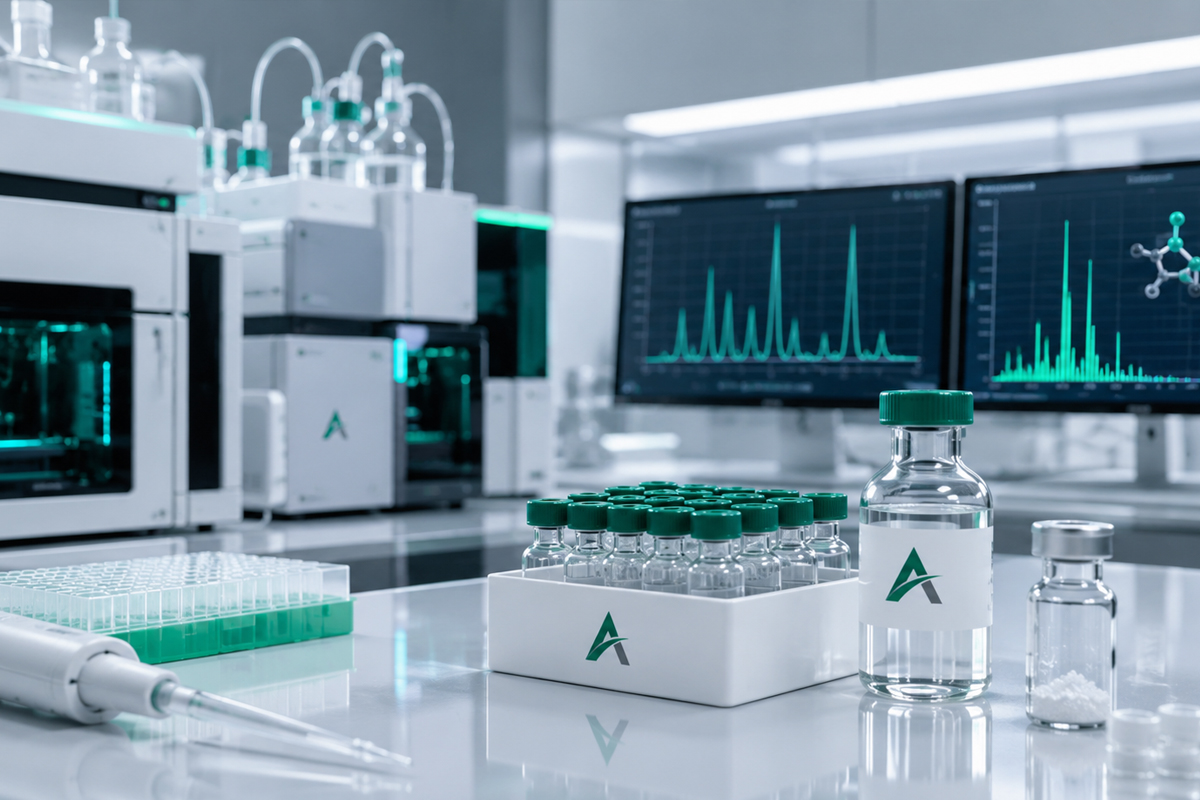
An HPLC chromatogram normally displays detector response against retention time. The principal peptide may appear as a dominant peak, while smaller peaks can represent other detectable components within the sample.
Researchers reviewing a chromatogram should consider:
- Whether the main peak is clearly defined
- Whether smaller peaks are visible
- Whether any peaks appear unusually broad
- Whether the baseline is stable
- Whether the complete run is shown
- Whether the integration marks are visible
- Whether the stated percentage matches the displayed data
A heavily cropped chromatogram or a report showing only the final percentage provides less information than a complete analytical record.
What HPLC Cannot Confirm on Its Own
HPLC is valuable for separation and relative purity assessment, but it may not prove the exact molecular identity of the principal peak. Different compounds can sometimes display similar retention behaviour under particular conditions.
HPLC alone may not establish:
- The expected molecular mass
- The precise amino-acid sequence
- The quantity contained in the vial or pen
- The concentration of a liquid presentation
- Sterility
- Endotoxin status
- Clinical safety
- Regulatory approval
For stronger identity evidence, HPLC is frequently combined with mass spectrometry through an LC-MS method.
What Is LC-MS Peptide Testing?
Liquid chromatography-mass spectrometry combines chromatographic separation with molecular mass analysis. The liquid chromatography stage separates the components within the sample, while the mass spectrometer examines the ions generated from those components.
LC-MS can help determine whether the sample produces a molecular signal consistent with the expected peptide. This makes it useful for investigating product identity and detecting certain related compounds or degradation products.
LC-MS may provide information about:
- The observed molecular mass
- The expected molecular ion
- Multiple charge states
- Related molecular species
- Potential degradation products
- The presence of more than one peptide component
- Whether the declared compound is consistent with the sample
A matching molecular mass provides useful identity evidence, although complete sequence confirmation may require additional analytical techniques.
How Mass Spectrometry Supports Peptide Identity
Mass spectrometry measures the mass-to-charge ratio of ionised molecules. Peptides frequently generate several charge states, which means the raw spectrum may display multiple signals associated with the same molecule.
Analytical software can deconvolute these charge-state signals to calculate an estimated molecular mass. Researchers can then compare the observed value with the expected mass of the declared peptide.
A strong identity assessment should consider:
- The expected molecular mass
- The observed molecular mass
- The acceptable difference between the two values
- The presence of supporting charge-state signals
- The possibility of salts, counterions or modifications
- Whether degradation products are present
A molecular signal that does not correspond with the expected compound should be investigated before the material is incorporated into a research programme.
HPLC vs LC-MS: What Is the Difference?
HPLC and LC-MS provide complementary information. HPLC is commonly used to estimate relative chromatographic purity, while LC-MS provides stronger evidence relating to molecular identity.
| Method | Main Purpose | Information Provided | Key Limitation |
|---|---|---|---|
| HPLC | Separation and purity assessment | Retention times, peak areas and relative purity | May not confirm exact molecular identity |
| LC-MS | Separation and molecular identity analysis | Mass-related signals and observed molecular mass | Does not automatically confirm total quantity |
| Quantitative testing | Measurement of target-compound quantity | Estimated amount of peptide present | Requires an appropriate validated method |
| Batch verification | Traceability | Connection between the report and supplied product | Only meaningful when identifiers match |
The strongest documentation normally combines identity, purity, quantity and traceability rather than relying on one analytical method.
Why Peptide Quantity Requires Separate Testing
A common misunderstanding is that a high HPLC result proves the stated amount of peptide is present. It does not. A product can be highly pure relative to the detected components while containing less total target material than expected.
Quantity testing is intended to determine how much target compound is present in the submitted sample. Depending on the product and method, this may involve calibrated analytical standards, quantitative chromatography or other validated procedures.
Researchers should check whether a report clearly distinguishes between:
- The stated label quantity
- The measured peptide quantity
- The chromatographic purity result
- The liquid concentration, where relevant
- The total sample weight
These figures should not be used interchangeably.
What Is Batch Verification?
Batch verification is the process of confirming that the analytical documentation relates to the exact production lot being purchased. Every peptide batch should have a unique batch or lot identifier that can be compared with the product label and test report.
Researchers should check that the following details match:
- The complete product name
- The compound identity
- The product presentation
- The stated quantity
- The batch or lot number
- The date of analysis
- The sample description
- The expected molecular mass
- The testing provider
A report produced for an older production run should not automatically be treated as evidence for current stock. Manufacturing, purification, filling, packaging and storage may differ between batches.
For further detail, read Why Batch Testing Matters When Buying Research Peptides UK.
Why Batch-Specific Testing Matters
Batch-specific testing supports traceability and allows researchers to connect analytical results with a particular production lot. It also helps distinguish current stock from a previous batch that may have been manufactured, purified or stored under different conditions.
Batch-to-batch differences can potentially arise from:
- Raw-material quality
- Peptide synthesis
- Purification efficiency
- Drying or filling procedures
- Liquid preparation
- Packaging
- Storage conditions
- Transport conditions
Researchers should avoid relying on a generic certificate displayed across every product size or production run.
How to Read a Peptide Certificate of Analysis
A Certificate of Analysis, usually shortened to CoA, summarises the analytical work performed on a product sample or batch. The level of detail can vary significantly between suppliers and testing laboratories.
A useful CoA may include:
- The complete product name
- The declared peptide sequence
- The molecular formula
- The expected molecular mass
- The observed molecular mass
- The HPLC purity result
- The complete chromatogram
- The mass spectrum
- The measured quantity where assessed
- The batch or lot number
- The testing date
- The testing laboratory’s details
A certificate should not be accepted simply because it displays a supplier logo, laboratory name or high purity percentage. The report must correspond with the exact product and batch under consideration.
Read Understanding Peptide Certificates of Analysis and Janoshik Testing for a more detailed guide to reviewing analytical documentation.
What Is Janoshik Testing?
Janoshik is an independent analytical testing provider frequently referenced within the research peptide sector. Depending on the services requested, a report may contain chromatographic purity data, mass-based identity information and quantitative analysis.
Researchers reviewing a Janoshik report should check:
- The report verification details
- The sample description
- The testing date
- The reported purity
- The measured quantity
- The identity information
- The report number
- Whether the sample matches the relevant batch
An independently verifiable report can provide valuable information, but it should still be checked carefully to ensure it relates to the exact product being purchased.
Testing Reta Pens
Pre-mixed research pens require documentation that corresponds with the finished liquid presentation. Researchers should confirm the identity of the target peptide, the total quantity present and the batch reference associated with the completed product.
Apex Pharma supplies two Reta Pens: Reta Pen 20mg and Reta Pen 40mg. The documentation should clearly identify which presentation was tested.
Researchers assessing a pre-mixed Reta pen should check:
- Confirmation of retatrutide identity
- The total measured peptide quantity
- The liquid concentration where reported
- The finished-product batch number
- The chromatographic purity
- The testing date
- The product-specific storage requirements
A report for Reta Pen 20mg should not automatically be applied to Reta Pen 40mg. Each product size should be supported by appropriate documentation.
Researchers comparing the two formats can read Reta Pen 20mg vs Reta Pen 40mg: Choosing the Right Research Presentation.
Testing Reta Vials
Traditional Reta Vials should also be supported by product-specific and batch-specific analytical information. Researchers should verify the compound identity, stated quantity, purity result and physical presentation before incorporating the material into an approved research programme.
Products such as Reta 20mg are supplied in a different format from pre-mixed Reta pens. A report relating to a vial should not automatically be used as evidence for a finished pen presentation, even where both products contain the same declared research compound.
Researchers should review the complete product specification and avoid assuming that identical headline quantities guarantee identical preparation, concentration or handling requirements.
Bac Water 10ml and Peptide Testing
Bac Water 10ml is supplied as a separate laboratory preparation product. Testing performed on bacteriostatic water does not confirm the identity, purity or quantity of a peptide product.
Researchers should assess the peptide and preparation material independently. Compatibility depends on the compound, formulation, analytical protocol and product-specific technical information.
Bacteriostatic water should not be added to a pre-mixed research pen unless the relevant documentation expressly requires it.
How Storage Can Affect Peptide Purity
Peptide quality can change after manufacturing if the material is exposed to unsuitable environmental conditions. Heat, moisture, light and repeated temperature fluctuations may contribute to degradation.
Potential analytical signs of degradation can include:
- Additional HPLC peaks
- A reduction in the principal peak area
- Changes in retention time
- New mass-related signals
- Unexpected discolouration
- Changes in physical appearance
- Altered solubility
Researchers should follow the product-specific storage instructions and maintain accurate records of delivery dates, storage locations, temperature conditions and batch numbers.
Common Problems with Peptide Testing Claims
Peptide testing claims should be reviewed critically. A high purity figure or certificate image may appear convincing while omitting important product and batch information.
Potential warning signs include:
- A purity percentage with no chromatogram
- A report with no batch or lot number
- A certificate for a different product size
- An old report used for current stock
- No molecular identity information
- A quantity claim based only on HPLC purity
- Testing performed before the final product was prepared
- Unreadable, cropped or edited documentation
- Unsupported pharmaceutical-grade claims
- No method details or testing date
A reliable report should clearly identify the sample, testing methods and analytical results.
Choosing a Reliable Peptide Supplier in the UK
A reliable supplier should provide transparent product information and make it possible for researchers to understand what has been tested. It should distinguish molecular identity, purity and quantity rather than combining them into one unsupported quality claim.
Researchers should consider whether the supplier provides:
- Clear compound names
- Consistent product quantities
- Current batch documentation
- Verifiable analytical reports
- HPLC and mass-based information where applicable
- Product-specific storage guidance
- Secure packaging
- Accessible customer support
- Responsible research-use notices
- No unsupported medical claims
For further procurement guidance, read How to Choose a Reliable Peptide Supplier in the UK.
Applying Purity Testing Across the Apex Pharma Range
The principles of identity, purity, quantity and batch verification can be applied across different research compounds. However, the most appropriate analytical method may vary according to the molecule, presentation and research objective.
SS-31 10mg
Mass-based testing can help determine whether a sample is consistent with the expected SS-31 molecule, while HPLC can provide information about chromatographic purity.
TB-500 10mg
Molecular identity information is particularly important for products where a commercial name may not fully describe the precise peptide specification.
AHK 50mg
Chromatography and mass spectrometry can support controlled investigation of the sample’s purity, identity and stability.
Semax 10mg
Analytical documentation should correspond with the expected Semax molecule, stated quantity and current production batch.
Selank 10mg
Researchers should review molecular identity, chromatographic purity, measured quantity and batch details before laboratory use.
NAD+ 100mg
NAD+ is not a peptide, but identity, purity, quantity and batch traceability remain important analytical considerations.
Testing performed for one product should not automatically be assumed to represent another compound, presentation size or manufacturing batch.
Peptide Testing Checklist
Before purchasing or evaluating a research peptide, laboratories may find it useful to complete the following checks:
- Confirm the complete product name
- Check the declared peptide or compound
- Confirm the stated total quantity
- Review the batch or lot number
- Check the date of testing
- Review the HPLC purity result
- Inspect the chromatogram where available
- Review the LC-MS or mass spectrum
- Compare the expected and observed molecular mass
- Check whether quantity was measured separately
- Confirm that the report matches the product format
- Review the storage instructions
- Verify the testing provider where possible
- Confirm that the product is labelled for research use
Frequently Asked Questions About Peptide Purity Testing
What is the most common method used to test peptide purity?
HPLC is commonly used to estimate chromatographic purity by separating the components within a sample and comparing their detected peak areas.
Does a 99% HPLC result prove that the peptide is genuine?
No. A high HPLC result indicates that one component accounts for most of the detected chromatographic signal. LC-MS or another identity method is normally required to help confirm the expected molecule.
What is the difference between HPLC and LC-MS?
HPLC is mainly used for separation and relative purity assessment. LC-MS combines separation with mass analysis and can provide stronger evidence relating to molecular identity.
Does high peptide purity confirm the amount in the vial?
No. Purity and quantity are separate measurements. A dedicated quantitative test is required to estimate how much target peptide is present.
Why must a Certificate of Analysis match the batch number?
A matching batch number helps establish that the test report relates to the same production lot as the product being purchased.
Can a report for Reta Pen 20mg be used for Reta Pen 40mg?
No. Documentation for Reta Pen 20mg should not automatically be applied to Reta Pen 40mg. Each finished presentation should have appropriate product and batch information.
Does high purity mean that a peptide is sterile?
No. Chromatographic purity does not establish sterility or endotoxin status. These require separate testing procedures.
What should researchers check on a Janoshik report?
Researchers should check the sample description, report number, testing date, purity, quantity, identity information and whether the report matches the exact product batch.
Why is finished-product testing important for pre-mixed pens?
Finished-product testing can help verify the identity, quantity and purity of the peptide within the completed liquid presentation rather than only testing the raw material.
Are independently tested research peptides suitable for personal use?
No. Analytical testing does not convert a research product into an authorised medicine or establish that it is suitable for consumption, administration or personal experimentation.
Important Research Use Notice
All peptides and related compounds supplied by Apex Pharma are intended exclusively for controlled laboratory, analytical and scientific research. They are not authorised medicines, dietary supplements, medical devices or consumer healthcare products.
HPLC, LC-MS and batch testing provide information only within the scope of the methods performed. These results do not establish clinical safety, sterility, regulatory approval or suitability for personal use.
Research products must not be consumed, self-administered, injected, used therapeutically or incorporated into personal experimentation. They should only be handled by suitably trained personnel within an appropriate laboratory environment.